Milton Keynes Hospital expedites care for Royal Navy veteran with Service-attributable injuries
Healthcare - Priority treatmentEnglandSpecial provisionAugust 2, 2024
A veteran with a Service-related spinal injury faced a two-year wait for treatment, resulting in pain and reduced mobility.
What was the situation?
Lee, 61, is a Royal Navy veteran who served for 8 years. During his service, he suffered a spinal injury when his ship rolled and he fell down a hatchway. Lee spent three months in traction at the Royal Naval Hospital in Haslar, before surgery to repair the injury and fuse the spine, leaving him with pain and limited movement. Periodic flare-ups required medical intervention to reduce the pain radiating down both legs.
Things came to a head again when Lee underwent an MRI in January 2023. This showed four damaged discs in the lower back, along with intense pain and an inability to walk very far, bend or move effectively. Lee was referred to the pain management team at Milton Keynes Hospital. He was informed that the wait time to be seen could take up to two years.
Lee continued to be in significant pain and was increasingly frustrated. He contacted the Patient Advice and Liaison Service (PALS) office. He ticked the ‘Have you served?’ box and was connected to the Trust’s Armed Forces Covenant Support Officer.
What was done to help?
The PALS team quickly contacted the Armed Forces Covenant Support Officer, who made contact with Lee. They spoke at length about his condition and issues around delay in treatment. MK Hospital had recently been awarded the Veterans Covenant Healthcare Alliance ‘Veteran Aware’ accreditation, part of which involves delivering training to staff to inform them about the principles of ‘due regard’ for those with Service-attributable injuries.
The Covenant Officer liaised with the appropriate teams within the hospital, and also the local physiotherapy clinic, to ensure Lee’s injury was recorded as Service-attributable, and dealt with in accordance with the Covenant Legal Duty guidance around provision of services and priority treatment. Lee’s care was expedited, and the Covenant Officer kept in regular contact to ensure things progressed smoothly.
Lee was also informed about other support available to him through Armed Forces charities, such as the Battleback centre and Veterans Pain Management clinic. He was also connected to the wider local Armed Forces community and invited to veterans’ breakfast clubs and civic events. Lee, himself with a background in mental health and psychology, is hoping to become more involved in supporting the veteran community once his condition allows.
What made this special provision?
This veteran is among those sacrificing the most, having suffered a spinal injury because of Service. His sacrifice made it appropriate for MK Hospital to consider special provision for him.
The hospital’s support counted as special provision, as, to recognise his sacrifice, it provided him with care sooner than civilians with a similar need.
What was the outcome?
Lee was given priority treatment for his condition in line with the principles of ‘due regard’ under the Armed Forces Covenant Legal Duty. Although not yet pain-free, he is more mobile and glad to have been heard and listened to at Milton Keynes Hospital.
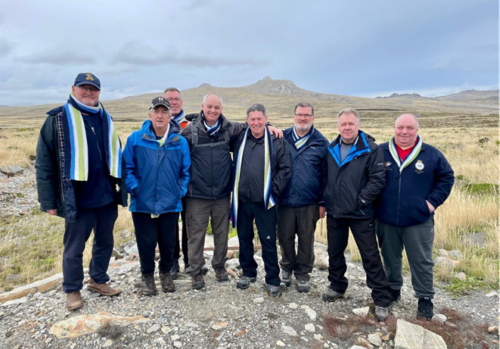 He has since enjoyed a trip back to the Falkland Islands with some old ship mates. Lee had not been back since 1982. He sent the attached picture taken on top of The Two Sisters, which saw action during the Falklands Conflict. Lee said:
“Without my back being sorted, my trip to the Falklands would not have been possible. I had the last procedure three days before I flew down, and it’s much better.”
The Covenant Officer keeps in contact, and Lee knows that should he need it again, there is support available to those who have served at Milton Keynes Hospital.
Wider information
You can read more widely about:
- Covenant disadvantage and special provision (the two types of case study in this database)
- Covenant support for the Armed Forces community: Healthcare
- How NHS bodies can support the Armed Forces community and implement the Covenant
Disclaimer: This case study is part of the Covenant case study database. MOD has developed the database to illustrate examples of good practice for organisations in scope of the Covenant. It serves as a guide for effective Covenant delivery, offering practical insights into achieving fairness for the Armed Forces community. Delivery of the Covenant may vary across the UK. This means there is no guarantee the solution outlined in this case study is available in your area.