
Covenant action for schools
Schools can support the Armed Forces community and implement the Covenant by:
 Mitigating the impacts of military life on Service children
Your school might educate:
- Children of currently serving members of the UK Armed Forces, or children of their partners or ex-partners
- Children of former members of the UK Armed Forces (‘veterans’), or children of their partners or ex-partners
- Bereaved children of parents who died on service in the UK Armed Forces, or bereaved children of their partners or ex-partners
- Children who are currently serving Reserve members of the UK Armed Forces
- Children who are themselves veterans of the UK Armed Forces
These are called ‘Service children’. Some of these Service children might face disadvantages compared to non-Service children, arising from military life, when at your school. For example, an interrupted education caused by a mobile lifestyle. Your school might be able to mitigate some of these disadvantages.
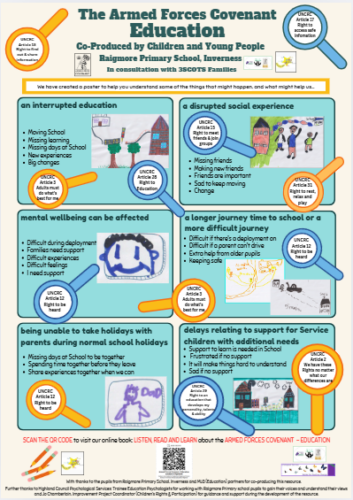
Your school might also have opportunities to offer special provision to those children sacrificing the most, such as the bereaved.
Find out more about mitigating the impacts of military life and offering special provision.
Since November 2022, governing bodies of certain state-funded schools have been legally obliged to have due regard to the Covenant principles when carrying out certain functions. Find out more about the Covenant Legal Duty.
Thriving Lives Toolkit for schools
The Service Children’s Progression Alliance is a partnership of organisations focused on improving outcomes for Service children, hosted by the University of Winchester and supported by the Ministry of Defence. The Alliance undertook extensive, targeted research, working in collaboration with schools and other partners across the UK, to establish a toolkit.
Access the toolkit here: Thriving Lives Toolkit
This toolkit helps schools ensure they provide effective support to Service children. It provides detailed resources including the evidence base, what schools can do to support their Service children, who can help, and a range of case studies. The toolkit provides a framework of 7 principles through which schools can reflect on their practice and a 3-tier set of CPD resources. The principles are as follows.
- Clarity of approach – Leaders’ understanding and approach ensure resources and policies improve Service children’s outcomes.
- Wellbeing is supported – Tailored pastoral provision supports Service children‘s mental health and wellbeing.
- Achievement is maximised – Teaching, assessment and support ensure the continuity of Service children’s learning and progression.
- Transition is effective – Systems and support ensure seamless transitions for Service children arriving at and leaving school.
- Children are heard – Service children’s diverse voices are heard and inform the support they receive.
- Parents are engaged – Strong home-school partnerships help Service families feel valued as part of the school community.
- Staff are well-informed – Supportive training and networks ensure all staff understand and support each Service child.
Employing members of the Armed Forces community
Your school might employ:
- Currently serving Reserve members of the UK Armed Forces
- Family members of someone currently serving, or someone formerly serving, in the UK Armed Forces
- Veterans of the UK Armed Forces
You can be a Forces friendly employer of members of the Armed Forces community, receive awards that recognise your commitment to the Covenant, and get help and advice. Find out more about employing members of the Armed Forces community.
Show your support
Have a section on your school’s website dedicated to the Armed Forces community. This could feature:
- A copy of your signed Covenant pledge and Employer Recognition Scheme award.
- Information about support or benefits your school provides to pupils, employees and job applicants from the Armed Forces community.
- News, events, or updates related to the Armed Forces community.
- Contact details for your specialist support or liaison staff for the Armed Forces community.
Find out other ways to show your support.